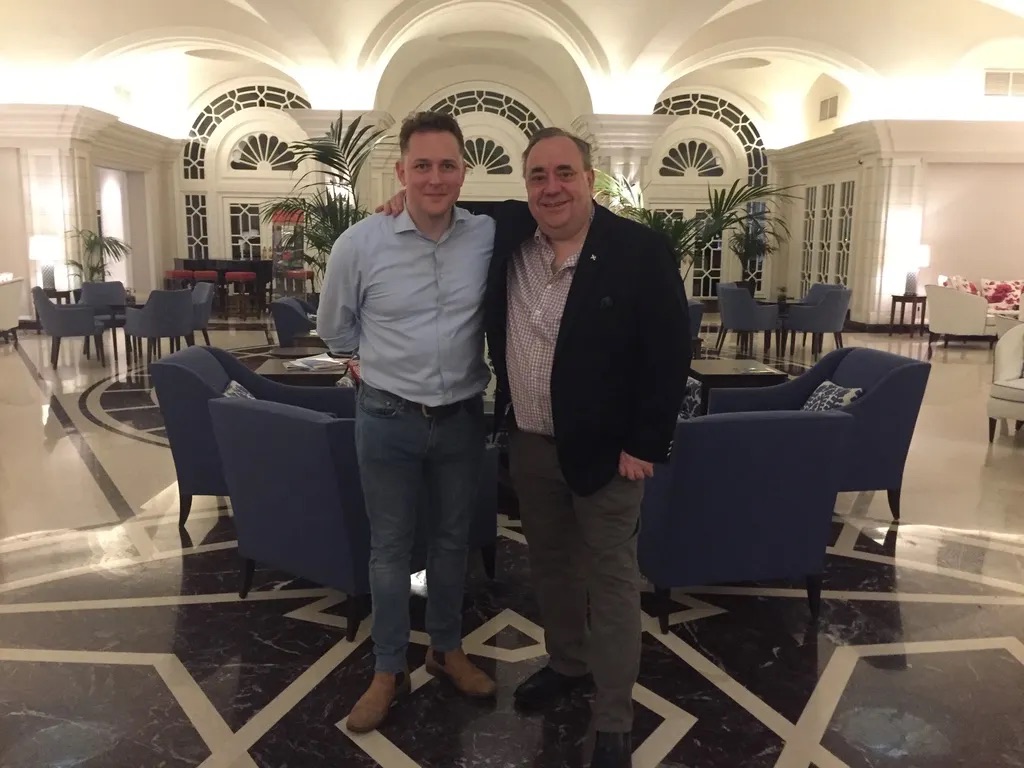
BBC Scotcast – Kirk Torrance appeared on BBC Scotcast on 23 February 2026. An extended version aired on BBC Scotland and is available on iPlayer.
This article makes one argument. The Supreme Court's own reasoning shows that a clear pro-independence majority in a Holyrood election carries democratic authority Westminster cannot credibly dismiss. The D'Hondt arithmetic shows that 1.09 million SNP list votes in 2021 returned two MSPs — and what a second independence party could have returned instead. Everything else follows from those two facts.
You believe Scotland should be independent. You have watched leaders tell you the route is blocked, the moment is not right, the conditions are not favourable. You have been asked to be patient. You have been patient. And now, with ten weeks to a Holyrood election, you are being told that a party on the verge of financial collapse is the last hope of the independence cause.
That is not a strategy. That is a symptom of a movement that has spent three years mourning a loss it does not yet understand. The Supreme Court’s November 2022 ruling – unanimous, five judges, no dissent – did close one door. But in the very reasoning the judges used to close it, they left a blueprint on the table. A blueprint that points directly to the 2026 Holyrood election. Most people in the independence movement have never read it. That omission is the movement's central strategic failure.
I appeared on BBC Scotcast last night to discuss Alba Party’s difficulties. There was not time to say what needs to be said. This is the longer version of that conversation – not about Alba, not about personalities, and not about which party deserves your loyalty. This is about you, your two votes, and the constitutional mechanism by which Scotland's sovereign people can produce a democratic mandate that no government on earth can credibly dismiss.
The Door They Closed – And Why They Closed It
The judgment is not ambiguous. The Scottish Parliament cannot legislate for a referendum on independence because the matter ‘relates to’ reserved matters under the Scotland Act – specifically the Union of the Kingdoms and the sovereignty of the UK Parliament. The court ruled that even a purely advisory referendum, with no immediate legal effect whatsoever, fell outside Holyrood’s legislative competence. Every major Westminster party has confirmed it will not grant a Section 30 Order. That position has not softened.
Anyone still describing a 'legal path to a referendum' without addressing these twin realities is providing comfort, not strategy. The first thing you must accept is the world as it is. Grief is not a plan.
But here is what is never said clearly enough: the Supreme Court did not block the referendum because a consultative vote would have been meaningless. It blocked it because a consultative vote would have been powerful. Even a non-binding referendum, returning a clear Yes majority, would have constituted precisely the kind of democratic expression that a government founded on democratic principles cannot indefinitely refuse to recognise. The court understood that. So it stopped it at source. And in doing so, it explained – in its own words – exactly what a democratic mandate looks like and why it carries authority. Those words are the independence movement's greatest unused asset.
Read What the Court Actually Wrote
The independence movement has quoted the Supreme Court ruling as evidence of defeat. It should be quoting it as evidence of the route forward. Here is paragraph 81 of UKSC 2022/0098, in full – because the opening sentence is the one that matters most, and it is the one most often omitted:
A lawful referendum on the question envisaged by the Bill would undoubtedly be an important political event, even if its outcome had no immediate legal consequences, and even if the United Kingdom Government had not given any political commitment to act upon it. A clear outcome, whichever way the question was answered, would possess the authority, in a constitution and political culture founded upon democracy, of a democratic expression of the view of the Scottish electorate. The clear expression of its wish either to remain within the United Kingdom or to pursue secession would strengthen or weaken the democratic legitimacy of the Union, depending on which view prevailed, and support or undermine the democratic credentials of the independence movement. It would consequently have important political consequences relating to the Union and the United Kingdom Parliament.
Read the first sentence again. The court states that a clear democratic expression carries authority – even without immediate legal consequences, and even without a Westminster commitment to act upon it. The democratic expression itself carries authority. The court did not block the referendum because that authority was doubtful. It blocked the referendum because that authority was inevitable – and untenable for the sovereignty of Westminster Parliament within the UK’s unwritten constitution.
“A clear outcome… would possess the authority, in a constitution and political culture founded upon democracy, of a democratic expression of the view of the Scottish electorate.”
The principle the court articulates does not belong exclusively to referendums. It belongs to democracy. And democracy produces mandates through elections just as it produces them through referendums. A clear pro-independence majority returned by a Holyrood election carries precisely the authority paragraph 81 describes. The independence movement has a constitutional argument – grounded in the Supreme Court's own language – and it has barely begun to make it.
Westminster Has Always Recognised Elections
The independence movement has spent too long casting Westminster as an implacable opponent that will never recognise Scotland’s democratic will. That framing is both inaccurate and strategically counterproductive. Westminster is a democracy. Democracies recognise democratic mandates – when those mandates are clear and credible enough that to refuse would cost more than to concede.
The dominant mechanism of British decolonisation since 1945 was not the referendum. It was the election. India’s independence in 1947 was secured through elected Constituent Assemblies following the 1946 provincial elections – no independence referendum was held. The same is true of Ghana (1957), Nigeria (1960), Sierra Leone (1961), Tanganyika (1961), Jamaica (1962), Trinidad and Tobago (1962), Uganda (1962), Kenya (1963), Malawi (1964), Zambia (1964), Botswana (1966), Barbados (1966), Guyana (1966), Mauritius (1968), and Zimbabwe (1980) – all achieved through elections and constitutional conferences. The Bahamas became independent in 1973 following a 1972 general election explicitly fought on an independence mandate; Hansard records it as establishing “a substantial majority of the population… in favour of independence.” Belize became independent in 1981 following the 1979 general election, which set in motion, as Wikipedia records, “the chain of events that would lead to independence.” Malta in 1964 is the verified exception, where a constitutional referendum preceded independence.
Westminster recognised every one of these mandates. Not because it was compelled to at gunpoint, but because a democracy that indefinitely refuses to recognise clear democratic expressions of its own people's will eventually loses the argument it is making about itself. The historical record is not that Westminster demanded referendums. It is that Westminster recognised elections when the mandate they produced was clear enough to be undeniable.
The question for Scotland is therefore not whether Westminster will eventually recognise a sufficiently clear democratic mandate. The question is whether Scotland’s sovereign people will produce one. That question will be answered on 7 May 2026. Which means you need to understand what has been built to prevent it.
The System Was Built to Stop You
This is the part of the story that Scotland’s unionist establishment has never wanted stated plainly. Holyrood’s electoral system was designed – deliberately, in 1997, by the Labour Party – to ensure no single party could ever win a parliamentary majority. It was not designed to be fair. It was designed to be a permanent constitutional firebreak: a guarantee that Scotland’s electorate could never, through a devolved election, produce the kind of clear and undeniable mandate that would have to be recognised as the expressed will of the Scottish people.
The system’s designers understood the same principle the Supreme Court would later articulate in paragraph 81: a clear democratic mandate of the people is the gold standard of political legitimacy. They built Holyrood specifically to prevent that standard from ever being met through a devolved election. The stated objective was proportionality. The operational objective was permanent diffusion of independence-supporting political power. That is not a conspiracy theory. It is the documented political history of devolution, spoken plainly.
The architecture works like this. Voters have two ballot papers: one for their constituency MSP, elected by first past the post; one for the regional list, allocated across eight regions using the D’Hondt formula. D’Hondt divides a party’s regional list votes by the number of constituency seats it has already won, plus one. A party that sweeps every constituency has its list votes mathematically diluted into near-irrelevance. A party starting from zero constituencies has its list votes counted at full value. The more dominant the SNP becomes on the constituency ballot – that is, the more clearly the people express their will through the first vote – the more the system punishes that expression on the second.
The Supreme Court blocked the consultative referendum for precisely the same reason this system was designed: both are mechanisms for preventing a clear democratic expression of Scotland’s will from ever producing unavoidable consequences. The referendum was blocked at the point of competence. The election is being diluted at the point of arithmetic. The same logic, the same objective, a different mechanism.
In 2011, the People of Scotland Broke the System
Then came 2011. I was there. I led the digital campaign that helped make it happen. The SNP won an outright majority – the thing the system was built to make mathematically impossible. The consequences were immediate and unavoidable: a clear mandate existed, Westminster could not dismiss it, the Edinburgh Agreement followed, the 2014 referendum followed. The logic the system was designed to prevent had been triggered. The sovereign will of the Scottish people, expressed with sufficient clarity, could not be held back.
I created the ‘#BothVotesSNP’ campaign. At that time it was the right strategy: the SNP were not yet sweeping the constituencies, and therefore were not being penalised on the regional list. Both votes working together maximised SNP representation across all of Holyrood. That time has passed. The electoral landscape has changed fundamentally. The SNP now dominates the constituencies to the point where the regional list vote is structurally neutralised by D’Hondt’s corrective mechanism. The same strategy that was correct in 2011 is now mathematically self-defeating. What was once sound tactics is now, in changed conditions, a mechanism for wasting a million votes.
“Two elections have gone by where the SNP had a million votes on the list, and none of them counted towards anything. In one election they had one MSP on the list, and the other one in 2021 I think they had two. I mean, these are stark numbers.”
In 2021, the SNP won 62 of 73 constituency seats and received 1,094,374 regional list votes. Those 1.09 million votes returned two additional MSPs. Two. The D’Hondt formula penalises dominant parties at precisely the moment of their dominance: a party that has swept the constituencies has its list votes divided by the number of seats it has already won, plus one. Sixty-two SNP constituency wins meant that 1.09 million list votes were divided by 63 before the first allocation round. The system was not broken. It was working precisely as designed. What was catastrophically wasted was not the system's fault. It was the independence movement's failure to understand the system it was operating within.
A second independence party receiving those same 1,094,374 votes from zero constituency wins would have started with its votes undivided. Running D’Hondt across all 56 list seats on the actual 2021 figures produces the following results. At 30 per cent of the SNP’s list votes – roughly 328,000 votes – a second independence party wins 12 list MSPs. The Greens won 8 list seats from 220,000 votes. Even at 30 per cent, a second independence party surpasses what the Greens achieved, and the total pro-independence majority reaches 82 seats in a parliament of 129. The combined SNP and independence list bloc would have commanded two thirds of Holyrood on roughly the same votes that actually returned the Conservatives and Labour as a combined unionist bloc of 57.
At 60 per cent of the SNP's regional list vote – around 657,000 votes, less than two thirds of what the SNP already had in 2021 – the arithmetic reaches a decisive threshold. A second independence party wins 21 list seats. The Conservative Party, which was the official opposition in 2021 with 31 seats, is reduced to 20. The independence movement’s second party becomes the official parliamentary opposition. The pro-independence total reaches 90 seats out of 129. Unionist parties collectively fall to 39 MSPs. At the full 1.09 million SNP list votes, the numbers are unambiguous: 29 list seats for the second independence party, a pro-independence total of 96 MSPs out of 129, and a unionist rump of 33. Not a stained-glass coalition assembled after polling day. A democratic mandate of unmistakeable scale – precisely the 'clear outcome' paragraph 81 describes as carrying democratic authority in 'a constitution and political culture founded upon democracy.'
The List Vote for a second independence party would have been the independence guarantee. Not a hope, not a gamble – a mathematical guarantee, embedded in the architecture of the very system built to prevent it. That opportunity was obscured in 2021 by tribalism, by hurt, and by the kind of political betrayal that the independence movement has historically been more skilled at inflicting on itself than any unionist party ever managed. Those votes went to the SNP, returned two MSPs, and disappeared. The constitutional logic has not changed. The D’Hondt arithmetic has not changed. The opportunity – to deploy the regional list vote as the instrument that converts Scotland’s pro-independence electoral dominance into the irresistible parliamentary mandate paragraph 81 describes – has not changed. What remains to be seen is whether the movement will allow tribalism to repeat the same erasure in May 2026, or whether Scotland’s sovereign people will understand, this time, what those two ballot papers actually represent.
Now let us name what the unionist parties do, because the faux moral outrage about ‘gaming the system’ deserves to be stated plainly. Liberal Democrat supporters vote Labour in constituencies where Labour can beat the SNP. Conservative supporters do the same. Labour and Liberal Democrat supporters have been coordinating tactically for years, with a single explicit objective: keep the SNP out. They do not call it gaming the system. They call it tactics. The argument that the independence movement should not deploy its votes with equivalent intelligence is not a principled position. It is an argument made by people who benefit from the independence movement’s strategic naivety, aimed at the very people it is designed to disadvantage.
I am not advocating tactical voting. I am advocating strategic voting. The distinction matters. Tactical voting is reactive – it responds to the immediate contest in a single constituency. Strategic voting is systemic – it understands the architecture of the entire electoral mechanism and deploys votes to produce the outcome the voters actually want across the whole parliament. The goal is not to win individual seats. The goal is to produce the “clear outcome” that paragraph 81 states would “possess the authority, in a constitution and political culture founded upon democracy, of a democratic expression of the view of the Scottish electorate.” That requires intent, coordination, and the political maturity to subordinate tribal loyalty to strategic purpose.
The Voter Empowerment Mechanism
When advising Ash Regan during the SNP leadership contest in 2023, I developed what I termed the Voter Empowerment Mechanism: the principle that if pro-independence parties, standing on explicit independence mandates, secure more than 50 per cent of the vote in a Scottish election, this constitutes a clear democratic directive for independence negotiations to begin. That threshold is not arbitrary. It is the minimum level at which a mandate becomes irresistible – the point at which a majority of Scotland’s sovereign people have expressed, through the ballot box, that they wish their country to be independent.
That principle requires no referendum. It requires no Section 30 Order. It requires what every democratic mandate has always required: clarity, credibility, and sufficient scale that it cannot reasonably be characterised as anything other than the expressed will of the people. The historical record shows Westminster has recognised exactly that, repeatedly, in country after country. The Supreme Court’s own reasoning confirms the authority such an expression would carry.
But here is the critical point that the independence movement has failed to absorb: a stained-glass parliament – a fragile post-election coalition of different parties, assembled after polling day to reach a nominal majority – is not what paragraph 81 describes.
“They’re hoping if the Green Party comes through, then great. If there’s a few other independent MSPs coming through, then great. We can have a rainbow coalition. We can have a stained-glass Parliament, as I like to think of it. That might be pretty, but very fragile.”
The court spoke of a ‘clear outcome.’ A coalition of SNP, one or two Greens, and a handful of independents, representing fewer than half of Scotland’s actual votes, assembled after the fact to claim a constitutional mandate, is exactly the kind of thing Westminster can dismiss in forty-eight hours and be believed. A Holyrood parliament in which pro-independence parties have commanded a robust, cross-party popular majority – SNP constituencies plus a substantial bloc of list MSPs returned by a second independence party, together representing a genuine majority of Scottish votes cast – is something qualitatively different. It is the “clear outcome”. It is what produces a mandate that carries the democratic authority paragraph 81 describes and that cannot be credibly dismissed as a technicality.
The 20 Per Cent the Movement Is Losing
There is a number that should alarm every person who genuinely cares about independence: approximately 20 per cent of the Scottish electorate say they support independence but will not vote for the SNP. The Greens capture some of them. But most of that vote is drifting – and it is drifting somewhere that should concentrate the mind.
“Reform are looking at these demographics of people who are pro-independence but have nowhere to go. And that’s something the independence movement across the board needs to recognise and take seriously.”
Reform UK understand that the small-c conservative, economically liberal, socially traditional voter who supports Scottish independence has been comprehensively abandoned by a movement that has drifted so far to the progressive left that it no longer speaks their language. If the independence cause cannot field a credible home for those voters on the regional list, Reform will increasingly fill that space. That is not hypothetical. Reform received more than ten times Alba’s vote in Scotland at the last general election. These are people who believe in Scotland’s right to self-determination and are being pushed towards a party that is explicitly, structurally unionist. That is the cost of strategic incoherence. It is measurable, and it is growing.
A credible second independence party on the regional list is not merely a mathematical opportunity. It is the mechanism for capturing those votes before they are permanently lost, converting them into MSPs, and building the mandate that paragraph 81 describes as carrying democratic authority. The arithmetic and the politics point in the same direction. The question is whether the movement is paying attention.
Scotland’s Sovereign People Are Not Waiting for Permission
“I think there needs to be a sort of maturing of the independence movement. The sort of personal hostilities and the sort of tribalism needs to come to an end. I mean, I say everybody needs to grow up, and I say that towards people I have worked with and admire too.”
Scotland's people are sovereign. Not their leaders. The leaders are there to carry out the will of the people – not to instruct the people how to vote, not to tell them which party deserves their loyalty, not to manage their democratic expression into something tidier or more convenient for party machines. The Wee Fowk of Bannockburn did not win the day by waiting for their leaders to tell them what was possible. They held the field. They changed the course of history. The leaders’ job was to follow the momentum the people created, not to stand at the front of it and direct it towards their own purposes.
That principle has not changed. It is precisely the principle the system designed in 1997 was built to suppress. It is precisely the principle the Supreme Court’s own reasoning confirms: a clear democratic expression of the view of Scotland’s sovereign people cannot be indefinitely ignored in a constitution and political culture founded upon democracy. The system cannot suppress what is clear. The court cannot dismiss what is overwhelming. Westminster cannot refuse what is undeniable.
The personal hostilities, the tribalism, the score-settling – all of it must end. It must end because Scotland does not have the luxury of indulging it with ten weeks to a Holyrood election. SNP supporters who understand D’Hondt need to stop treating strategic list voting as disloyalty and start treating it as the act of democratic sophistication it is. Any second independence party that emerges must pursue the cause rather than its own institutional survival. The independence media must explain the arithmetic rather than dismiss list strategies as divisive. The movement's leadership must stop treating 2026 as a test of individual parties' strength and recognise it for what it is: the one electoral opportunity, within the window the Supreme Court's own reasoning has opened, to produce a mandate that carries genuine democratic authority.
I am confident we will see independence. Not because it is politically convenient but because it is, as I said on Scotcast, part of the human condition. The same impulse that drove nation after nation to produce a clear democratic mandate and demand to be recognised as free is not extinguished in Scotland. It is waiting to be properly deployed. The ballot box is the gold standard. It always has been. And in May 2026, the sovereign people of Scotland have the power to use it.
The argument above reduces to one question: are you going to let the system designed in 1997 to prevent your clear democratic expression succeed in its purpose? Or are you going to deploy your two votes with the strategic intent of a sovereign people who understand what is at stake?
Tomorrow, do two things. First: read paragraph 81 of UKSC 2022/0098 in full. Not a summary. Not a quotation in someone else’s article. The paragraph itself. Read it with one question in mind: what is the court saying about democratic authority, and where does that authority come from? Second: find a D'Hondt calculator for your region, enter the 2021 constituency results, and see precisely what your SNP regional list vote returned. Then ask yourself what a different choice on that ballot paper could have produced instead.
Share this article. Not because I am asking you to agree with every word, but because the argument it makes – grounded in the Supreme Court’s own reasoning, in verified historical record, and in the arithmetic of the system built to contain you – deserves to be read by every person in Scotland who believes this country should govern itself. The leaders of the independence movement will follow when the sovereign people make clear what they require. That is how it has always worked. That is how it worked at Bannockburn. That is how it worked in 2011.
The route exists. The historical record supports it. The constitutional logic supports it. The system built to prevent it can be broken again. The question is whether the sovereign people of Scotland will choose to break it.